
Planning a two- to three-week Asia trip starts with three decisions: where to go, when to go and how much to spend. With so many countries, cultures and experiences on offer, the secret is an itinerary that balances sightseeing, transport, stays and time to relax.
A 14- to 21-day trip can focus on one country, combine two or three nearby countries or cover several cities connected by convenient transport.
This guide explains how to plan an Asia trip step by step, with sample routes, a seasonal calendar, approximate budgets and practical tips for travellers departing from India.
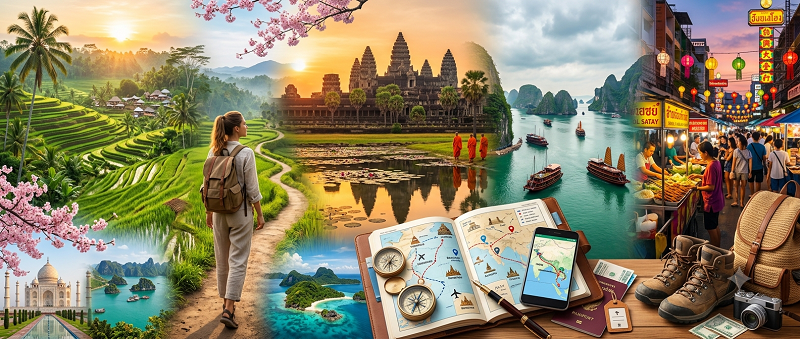
Before choosing destinations or booking flights, decide what you want from the trip. Your priorities will shape your route, accommodation, activities and budget.
Consider these questions:
Are you interested in culture, history, beaches, food, shopping, nature or adventure?
Do you prefer a relaxed holiday or a schedule full of activities?
Are you travelling solo, as a couple, with children or in a group?
What is your total budget, including flights and unexpected expenses?
Are your travel dates fixed, or can you adjust them to find better options?
Separate your must-see experiences from optional activities. This helps you pick destinations that match your interests instead of trying to tick off every popular attraction.
A solo traveller interested in culture might prioritise historic neighbourhoods and local food. A couple may prefer scenic stays and shared experiences, while a family needs convenient transport, child-friendly attractions and regular rest breaks.
Asia is far too large to explore comprehensively in two or three weeks. Instead of choosing by popularity alone, consider distance, transport links, seasonal conditions and the time needed for sightseeing.
For a first trip, one country or two or three well-connected destinations keep planning simple. Add another country only when the extra travel time and cost fit your priorities.
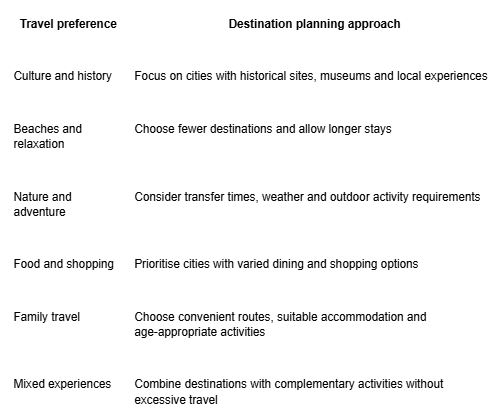
If you are unsure where to start, these combinations work well because the destinations are close together and well connected by flights or trains.
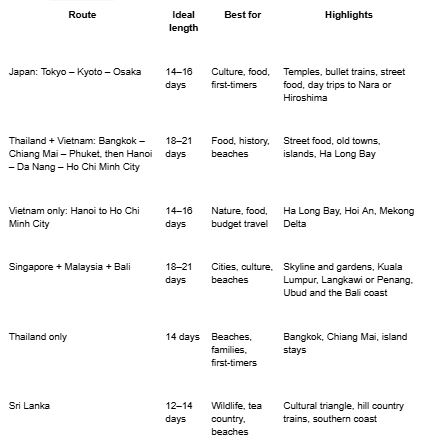
When comparing routes, look at flight availability, intercity transport, entry requirements, seasonal conditions and the total cost of the proposed trip.
Season matters more in Asia than most travellers expect. Monsoon rains, typhoons, extreme heat and festival crowds can all change the quality of a trip. Because Asia spans many climate zones, the best month for one country can be the worst for another.
The table below is a general guide. Weather patterns vary by year and region, so check a current forecast before booking.
Destination
Japan
Thailand
Vietnam (north)
Vietnam (central)
Vietnam (south)
Singapore
Bali, Indonesia
Malaysia
Sri Lanka.
Generally pleasant months
March–May (cherry blossom) and October–November (autumn colours)
November–February
October–April
February–August
December–April
Year-round, with February–April often drier
April–October (dry season)
Varies by coast; many travellers go December–March for the west coast
December–March (southwest and hill country), April–September (east coast).
Be careful about
Rainy season in June–July, very hot and humid August, typhoons late summer to autumn
Heavy rain from roughly May to October, very hot March–May
Cold, misty winters in the far north and hot, humid summers
Storms and flooding risk in autumn
Rainy season from May to November
Frequent short, heavy showers at any time
Rainy season roughly November–March
Monsoon differences between west and east coasts
Two monsoons affecting different coasts.
Peak seasons usually mean higher flight and hotel prices, so book earlier for those dates. Shoulder seasons often give a good balance of weather, crowds and cost.
Once you have shortlisted destinations, divide your days between arrival, sightseeing, transfers and departure. A travel day rarely gives you the same sightseeing time as a full day at a destination.
Include airport transfers, check-in and check-out, intercity journeys and recovery time after long flights. Avoid scheduling major activities right after a long journey or a tight connection.
Day
Day 1
Days 2–4
Day 5
Days 6–9
Day 10
Days 11–12
Day 13
Day 14.
Suggested plan
Arrive, transfer to accommodation and rest
Explore the first destination and its main attractions
Travel to the next destination
Explore the second destination and enjoy local experiences
Transfer to the final destination
Sightseeing, food and other planned activities
Flexible day for a favourite activity or unexpected changes
Departure.
Three weeks gives you time to explore in more depth, add a nearby location or include more rest days.
Day
Day 1
Days 2–5
Day 6
Days 7–10
Day 11
Days 12–16
Day 17
Days 18–19
Day 20
Day 21.
Suggested plan
Arrive, transfer to accommodation and rest
Explore the first destination, including major attractions and local experiences
Travel to the second destination
Explore the second destination at a comfortable pace
Transfer to the third destination, if applicable
Sightseeing, cultural experiences, food and other planned activities
Rest day or a nearby day trip
Complete remaining activities or revisit favourite places
Keep flexible for shopping, local experiences or departure preparations
Departure.
These are flexible templates, not fixed routes. If you choose only one or two destinations, use the extra days for longer stays, day trips or rest instead of adding unnecessary transfers.
Solo travellers: Allow flexibility for walking tours, independent exploration and meeting other travellers.
Couples: Balance shared experiences with free time and activities that suit individual interests.
Families: Plan shorter activity blocks, meal breaks and downtime, particularly with young children.
Groups: Agree on priorities before departure and allow time for coordination, reservations and different interests.
The main goal is an achievable itinerary. A well-planned trip lets you enjoy each destination without spending most of your holiday in transit.
Your budget should cover the complete journey, not just flights and hotels. Total costs depend on your departure city, destinations, travel season, accommodation standard, exchange rates and planned activities.
Include the following expenses:
International and regional flights
Accommodation, taxes and additional property fees
Trains, buses, ferries and local transport
Food and drinks
Attractions, guided tours and activities
Visa or electronic travel authorisation fees, where applicable
Travel insurance
Baggage charges, mobile data and other practical expenses
An emergency reserve for unexpected costs
Estimate transport costs: Add international flights, intercity journeys, airport transfers and local transport.
Calculate accommodation costs: Multiply the nightly rate by the number of nights, then add taxes and fees.
Estimate daily expenses: Multiply your expected daily spend on food and local activities by the number of travel days.
Add planned experiences: Include entrance tickets, tours, special activities and advance reservations.
Include additional costs: Account for visas, insurance, connectivity, baggage and other necessary expenses.
Set aside emergency funds: Keep a separate reserve for delays, changes or unexpected costs.
The figures below are rough per-person daily estimates in Indian rupees (₹) for on-ground costs such as accommodation, food, local transport and basic activities. They exclude international flights. Prices change with season, exchange rates and inflation, so treat them as a starting point and check current rates.
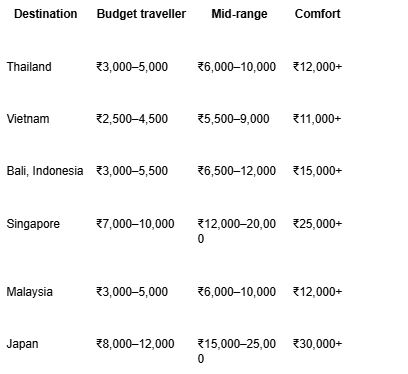
Avoid using a single daily budget for all of Asia. Costs differ sharply between Vietnam and Japan, and even between cities in the same country.
Solo travellers can save with hostels and public transport, while couples can compare shared accommodation options. Families should account for room occupancy rules, child tickets and larger rooms. Groups may save on shared stays or private transfers.
Transport affects both your budget and your sightseeing time. Compare the whole journey rather than choosing a ticket on its advertised price alone.
Before booking, check:
Whether a round-trip or multi-city (open-jaw) flight is more practical
The time and cost of reaching each airport
Baggage allowances and additional charges
Train, bus, ferry and domestic flight alternatives
Connection times and the risk of missed connections
Whether an overnight journey saves money but reduces rest
Whether airport transfers fit your arrival and departure times
Consider entering Asia through one city and leaving from another if it avoids backtracking. Compare the price with a standard return ticket before deciding.
If you book separate tickets, leave generous time between connections. The airline on your first flight may not protect your onward journey if a delay causes you to miss a separately booked flight.
Japan: Compare a regional rail pass with individual tickets. Whether a pass saves money depends on your route, so calculate before buying.
Southeast Asia: Low-cost airlines connect many cities cheaply, but check baggage fees and airport locations. Overnight trains and buses can save a hotel night but cost rest.
Ride-hailing: Apps such as Grab (widely used across Southeast Asia) and Gojek (Indonesia) are often easier than negotiating taxi fares. Check which apps work in each country.
Ferries and islands: Book ahead in peak season and keep buffer time, since weather can delay sailings.
Metro and city cards: Many cities offer prepaid transit cards that are cheaper and faster than buying single tickets.
Families may prefer fewer transfers and simple connections, while solo travellers may prioritise affordable public transport. Couples and groups should weigh cost savings against convenience and time.
If coordinating flights, hotels and transfers sounds overwhelming, a curated Asia tour packages can simplify the process by bundling these services. Independent planning gives you more control over pace and spending. Compare the full cost, inclusions, exclusions and flexibility of both before deciding. Many travellers also find that Asia tour package with flights make it easier to compare the total price at a glance, since airfare is usually the largest single expense.
Accommodation should match your itinerary, comfort needs and daily plans. A low nightly rate is not always the best deal if the property is far from public transport or the attractions you want to visit.
Before booking, check:
Location and access to public transport
Total price, taxes and additional fees
Room occupancy, bed arrangements and sleeping capacity
Cancellation, payment and refund policies
Check-in times and luggage storage
Recent guest reviews and facilities
Staying near a good transport connection can reduce daily travel time and make exploring easier. Solo travellers might prioritise safety, location and social spaces. Couples may want privacy and easy access to restaurants. Families should verify room size and child-friendly facilities, and groups should compare the cost of multiple rooms against larger properties.
Book essential accommodation early when your dates are fixed or you are travelling in a busy period. Flexible cancellation terms give you more options if plans change, but check the price and conditions first.
Entry requirements vary by country and depend on your nationality, passport, residency status, purpose of travel and length of stay. If you visit several countries, check the rules for each one, including transit points.
Indian passport holders face different rules in different Asian countries. In recent years, some destinations have offered visa-free entry for Indian citizens for limited periods, others use e-visas, and some require a standard visa application with supporting documents. These policies are changed or extended from time to time, so always confirm the current rule on the official immigration website or with the embassy before booking.
Indian travellers should also consider:
Direct flights: Many major Asian cities have direct flights from Delhi, Mumbai, Bengaluru, Kolkata and Chennai. Direct routes save time and reduce missed-connection risk.
Passport validity: Many countries require at least six months of validity from your date of entry, plus blank pages.
Proof documents: Onward tickets, hotel bookings, bank statements and travel insurance may be requested for visa applications or at immigration.
Processing time: Allow extra time for visa processing, especially for countries that need in-person appointments.
Check official immigration or embassy guidance for every country on your itinerary
Verify passport validity and available blank pages
Confirm whether you need a visa, e-visa or electronic travel authorisation
Check transit requirements for connecting flights
Review rules on onward tickets, accommodation details and proof of funds
Recheck entry requirements shortly before departure
Do not assume that permission to enter one Asian country allows entry into another. Families should also verify documents for children, including any consent or custody-related papers. Keep essential documents accessible in both digital and offline formats.
Money habits that work in India may not work abroad, so plan this before you leave.
Cash and cards: Carry a mix. Cards are widely accepted in cities and malls, but markets, small eateries and rural areas often prefer cash.
Forex: Compare rates between banks, authorised forex dealers and forex cards. Avoid exchanging large amounts at airport counters, where rates are often poor.
ATM fees: Foreign ATMs and your own bank may both charge fees. Check withdrawal limits and fees before departure.
Digital payments: UPI is accepted in a growing number of countries through partnerships, but availability is limited and changes over time. Check which destinations support it, and do not rely on it as your only method.
Local wallets and QR payments: Some destinations use QR payments heavily, but these may require a local account or specific cards.
Backup: Keep a second card and some emergency cash stored separately from your main wallet.
Notify your bank about international travel and confirm that international transactions are enabled on your cards.
A long list of attractions can look appealing on paper but become exhausting once you factor in travel time, queues, opening hours and weather.
Identify your top two or three priorities for each destination.
Group nearby attractions on the same day.
Reserve popular or timed-entry activities when necessary.
Check weekly closing days, seasonal access and weather.
Allow time for local food, spontaneous discoveries and rest.
Keep backup activities for bad weather or unexpected closures.
A solo traveller might join a guided walking tour. A couple may reserve one special experience and keep other days flexible. Families can alternate major attractions with parks or downtime, and groups can agree on essentials while leaving optional time for individual interests.
Avoid booking every hour in advance. A realistic itinerary leaves room for delays, fatigue and surprises.
Requirements depend on the countries you visit, your activities and your personal circumstances.
Review official health advice and recommended vaccinations for your destinations
Arrange travel insurance appropriate for your itinerary and activities
Carry necessary medication in its original packaging and check destination-specific restrictions
Save emergency numbers, accommodation details and important contacts
Keep digital and offline copies of essential documents
Check local laws, cultural expectations and common safety concerns
Families should prepare documents and supplies for travelling with children. Solo travellers may want to share their itinerary with a trusted contact, and groups should agree on meeting points in case anyone gets separated.
Packing checklist
Lightweight, breathable clothing, plus a light rain jacket for monsoon-prone regions
Comfortable walking shoes, since most trips involve a lot of walking
Modest clothing for temples and religious sites (covered shoulders and knees)
Universal power adapter and a power bank
Basic medicines, sunscreen, insect repellent and hand sanitiser
Photocopies or digital copies of passport, visa and insurance
Power plugs: Plug types differ across Asia. Japan uses two flat pins at 100V, Singapore and Malaysia use the three-pin UK-style plug, and Thailand and Vietnam accept several types. A universal adapter avoids problems, but check that your chargers support the local voltage.
eSIM vs local SIM: An eSIM can be set up before departure and activated on arrival, which is convenient if your phone supports it. A local SIM from the airport is often cheaper for heavy data use but may require your passport and some setup time. International roaming packs from your Indian operator are usually the simplest but can cost more. Compare options for each country.
Useful apps: Offline maps, a translation app, a ride-hailing app for each country, a transit app for rail-heavy destinations such as Japan, and your airline and hotel apps.
Trying to see too much. Four countries in two weeks usually means four airports and very little actual travel enjoyment.
Ignoring the season. A cheap flight in monsoon or typhoon season can cost you days of outdoor plans.
Booking tight separate tickets. A short layover between two separate bookings is a real risk if the first flight is delayed.
Forgetting jet lag and recovery time. Leave the first day light, especially after a long flight.
Relying on one payment method. Always carry a backup card and some cash.
Skipping visa checks for transit. Some connections require transit permission, even if you never leave the airport.
Overpacking. Many hotels are up stairs and many transport links involve walking. Pack light.
Not saving offline copies. Download maps, bookings and documents before you leave.
Before departure, review the whole trip to confirm that dates, transport, accommodation and activities fit together.
International and regional transport bookings are confirmed
Accommodation dates, locations and occupancy details are correct
Visa and entry requirements have been checked
Important activities are booked where necessary
Travel insurance and emergency contacts are accessible
The budget and emergency reserve are ready
Documents, payment methods and mobile connectivity are sorted
Airport transfers and intercity journeys have realistic time allowances
Essential reservations are saved for offline access
The itinerary leaves room for rest and unexpected changes
For families and groups, share the final itinerary with everyone and clarify which bookings and expenses are shared. Recheck airline updates, weather and entry rules shortly before you leave.
Planning a two- to three-week Asia trip is about choices that fit your priorities, budget and time. Define your goals, pick destinations that work together geographically, check the season and build a realistic 14- to 21-day itinerary.
Estimate the full cost, compare transport options, choose suitable accommodation and confirm entry requirements before you go. Keep room for rest and surprises.
If your plans change or you want a shorter break closer to home first, India has plenty to offer. Reading about Uttarakhand travel experiences can inspire a Himalayan weekend, and India holiday packages are a convenient way to plan a domestic trip while you save and prepare for your next international journey.
Whether you travel solo, as a couple, with family or in a group, the best Asia itinerary balances exploration with convenience. With thoughtful planning, you can make better use of your time, manage your spending and enjoy your journey without trying to do everything at once.
Yes. Two weeks can be enough to explore one country in depth or to combine a small number of well-connected destinations. The best itinerary depends on your interests, travel time and budget.
Three weeks gives you more flexibility to go deeper, add a worthwhile nearby location or include rest days. A longer trip is not automatically better if it adds unnecessary travel costs or rushed transfers.
There is no fixed number, but two or three is a comfortable limit for most travellers. Start with your must-see experiences and calculate the time needed for transport, entry formalities and sightseeing.
It depends on the country. Southeast Asia is generally more pleasant from roughly November to February, Japan is popular in spring and autumn, and Bali is typically drier from April to October. See the seasonal table above and check current forecasts.
Costs vary widely with destination, departure city, season and travel style. As a rough guide, on-ground daily spending can range from a few thousand rupees per day in Vietnam or Thailand to considerably more in Japan or Singapore, before adding flights. Use the budget table and calculation steps above to build your own estimate.
This changes with time. Several Asian destinations have offered visa-free or simplified e-visa entry to Indian passport holders in recent years, but rules are updated regularly. Check the official immigration website of each country before booking.
Compare flights and stays early, especially for peak periods. Check cancellation policies and entry requirements before committing to non-refundable bookings.
A tour package can simplify coordination, while independent planning offers more control. If you prefer a ready-made route, browse Asia tour packages to compare itineraries, inclusions and prices before you decide.
Choose destinations that connect conveniently, limit hotel changes and account for transfer time when planning sightseeing. Leave open periods for rest and add another destination only when the extra travel is worth the time and expense.